




I recently heard someone say on a podcast: “You can’t really do cross-border planning if you haven’t lived it.” I have lived it – and learned important life and financial lessons in the process.
My life has been shaped by moving between places since I was 16—starting with a summer in France, then working for many years in that same country, plus stints in the Netherlands and India. These days, we spend a few months a year in Oxford, UK, where my husband works on climate change research at University of Oxford.
It’s a life I feel incredibly lucky to live. And it’s more complicated than it might look from the outside.
The Oxford side
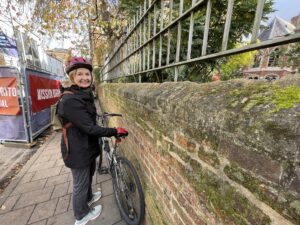 Living in Oxford is, in many ways, pure joy.
I trade my car for a bike. I ride through narrow streets in the rain, past buildings that are older than our entire country. I go to Evensong in these incredible chapels and meet friends at pubs that feel unchanged since generations.
What stands out most is the mindset. In Palo Alto, California, where we usually live, surrounded by Stanford and the tech world, there’s a constant sense of forward motion—what’s next, what’s bigger, what’s scalable.
Oxford feels different. People are studying things simply because they care about them—medieval women, public health in developing countries, philosophy. There’s a kind of intellectual curiosity that isn’t always tied to an outcome.
It’s refreshing. In this environment, I naturally slow down and reflect more.
The part no one sees: logistics
But living between two countries is not easy. It requires a surprising amount of effort behind the scenes.
We spend a lot of time counting days—literally—tracking where we are for tax residency purposes. That alone can feel like a part-time job.
And the rules keep changing. What might have been manageable 15–20 years ago is now much more complex. In practice, that means:
- Working with multiple cross-border tax professionals
- Keeping up with evolving regulations
- Managing different banking systems, currencies, and credit cards
- Thinking through things like: what happens to your umbrella insurance in such situations? Medical insurance?
None of these parts are glamorous, but it’s essential if you want this lifestyle to work.
The small things matter more than you’d think
 One of the more surprising challenges has been the day-to-day logistics of not having a “fully yours” home in both places.
In Oxford, we stay in short-term housing—homes owned by other academics or rented through university networks. Over time, I realized how much small things matter. Now I attempt to create a sense of normalcy in a home that isn’t quite ours.
At various points, I’ve bought cooking pans, French presses and a bread knife, which I leave stored at a friend’s house – who is kind enough to store these items plus our bicycles and an extra suitcase until we return to the UK.
The knife purchase was a cultural experience. Knives are kept locked away in UK stores, the way guns are in the US!
The financial reality
There’s also an interesting financial dynamic to all of this.
Every time we leave California, our credit card bills plunge. It’s a stark reminder of how expensive it is to live in the San Francisco Bay Area!
Even though we’re still paying for a home in the US and traveling internationally, many day-to-day costs in the UK are lower—food, transportation, and services. It balances out more than you might expect.
That said, it only works because we’re intentional about planning.
The emotional side (the hardest part)
The logistics and finances are manageable. The emotional side is harder.
It’s not easy to leave family – especially my mom, who has needed more family support recently – and be across the ocean. There’s always a bit of tension in that distance.
And then there are the transitions. Leaving the West Coast sunshine for a grey London arrival can be…an adjustment.
However, at the end of a long stretch of intense sun in California, typically late summer, I start to miss the seasons. I find myself craving the crisp air, the changing leaves, the slower rhythm of Oxford.
What I’ve learned
 Living between countries is incredibly rewarding, but it’s not something that runs on autopilot.
It takes planning. It takes flexibility. And it takes a willingness to live a little bit in between – never entirely settled in one place.
But for us, it’s worth it.
And from a financial planning perspective, it’s also a reminder: the more complex your life is, the more intentional your planning needs to be to support it.