Looking Back on the Transition
Recently, a colleague I studied with for the CFP® exam reached out to remind me of a major milestone: it has already been a full year since we passed the exam. It was a grounding moment. Now, it is literally just a matter of time — and a few more Experience hours — until I can officially use the CFP® marks.
What many people do not realize is that the CFP® designation requires far more than coursework and a comprehensive exam. Candidates must also complete 6,000 hours of real-world financial planning experience helping clients navigate complex financial decisions.
Whether I’m chatting with friends, peers from the Financial Planning Association (FPA), or my former engineering colleagues, the question I’m often asked is: “How did you end up here?”
Today, I wanted to share the story of that transition.
The Analytical Foundation
Looking back, my interest in personal finance started long before my professional career. As an Eagle Scout, I earned the Personal Management merit badge, which probably gave me a stronger financial foundation than many people get early in life. But the deeper motivation came from my grandfather, who passed away during my freshman year of college. After he died, I carried a quiet sense of responsibility to use my time and money wisely — not only for myself, but in a way that would have made him proud.
After college, I started my career in engineering. For several years, I did many of the things you are “supposed” to do financially: I bought a used car, lived with roommates, kept expenses reasonable, and focused on saving and investing early.
During COVID, my role was considered essential manufacturing support, so while much of the world slowed down, I continued going into work every day. Financially, that period accelerated things for me. With fewer distractions and lower spending, I was able to save and invest more aggressively than I ever expected.
But professionally, I was burning out.
By the summer of 2021, I hit a wall and resigned without a backup plan. At the time, I simply knew I needed a reset.
Discovering the Human Side of Systems
What engineering had taught me — and what I still value deeply — was how to think through complex systems and solve problems methodically. I even returned briefly to finish a project I genuinely enjoyed. But I also realized I wanted my work to feel more connected to people.
At that point, my understanding of “finance” was fairly narrow. I assumed the industry was mostly high-pressure sales or cold investment management.
Then I discovered the world of financial planning.
As I learned more about the CFP® curriculum, I realized it combined the analytical side of engineering with something I had been missing: the human side of problem solving. Behind every retirement projection, tax strategy, insurance recommendation, or estate plan is a real person trying to make important decisions about their life and future.
That realization changed everything for me.
Finding My Community
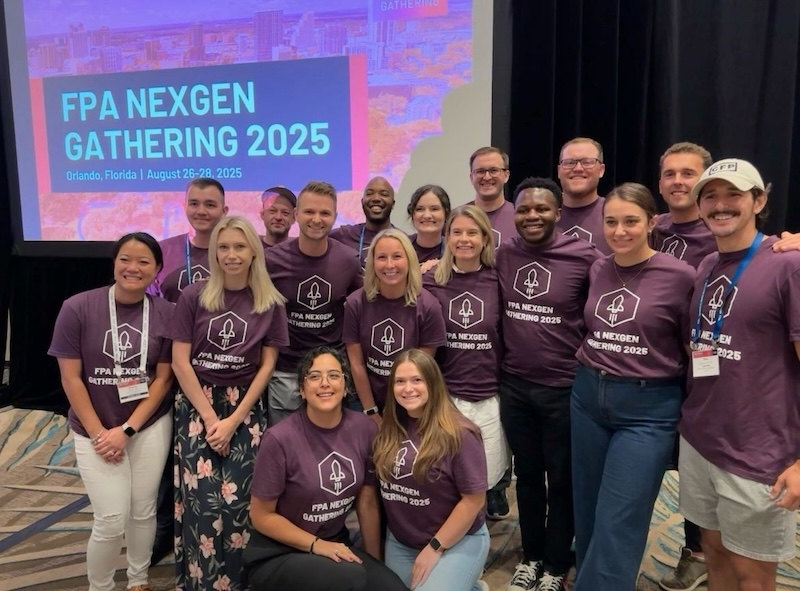
The turning point came when my friend Nichole encouraged me to attend an FPA conference called Gathering. I expected technical sessions and networking. What I found instead was an incredibly welcoming community of people who genuinely cared about helping others. I met planners who openly shared their own career paths and encouraged people like me who were entering the profession from different backgrounds.
That warmth gave me the green light I needed to seriously pursue the transition.
Soon after, I enrolled in a financial planning education program and started searching for a firm where I could learn what real financial planning looked like in practice. That search eventually led me to Emilie and Ariadne at Tamarind Financial Planning. At the time, they were not actively hiring, but they took a chance on me and created an internship opportunity so I could begin gaining experience.
Coming Home to Tamarind
In March 2025, I passed the CFP® exam. Shortly afterward, Emilie and Ariadne offered me a full-time position as an Associate Financial Planner.
Now, a year into the role, I can honestly say the work feels deeply meaningful to me. What I enjoy most is that good financial planning is not just about technical knowledge — though my engineering side enjoys that. It is about helping people feel more organized, confident, and intentional about their future.
I am currently completing my remaining CFP® experience hours and recently attended my first training in financial life planning through Money Quotient. The more I learn, the more I realize financial planning is as much about listening and understanding people as it is about numbers.
Looking back, changing careers felt risky at the time. But it also felt strangely like coming home.
I’m grateful I followed my curiosity, and I’m excited to continue serving Tamarind’s clients — using the problem-solving skills from my engineering background to help clients build brighter financial futures.